Please subscribe to my email newsletter for updates on my website and blog. You can do so in the sign-up block at the bottom of this page. Thank you!
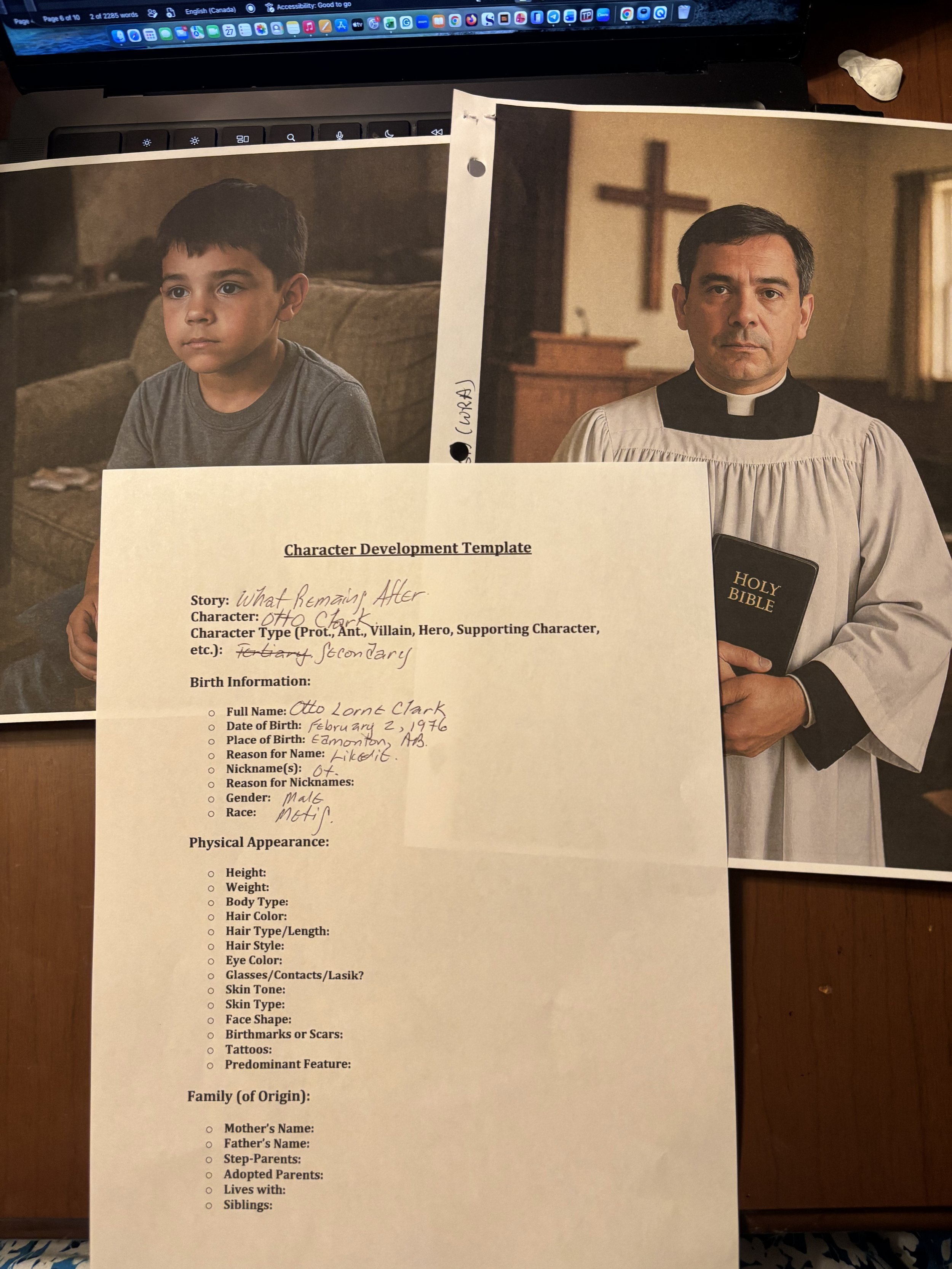
Images of Otto in photo are AI Generated. Not real people.
Why do some fictional characters seem to take on a life of their own? Most writers begin with carefully crafted outlines and clear plans for their characters, yet many find that believable characters resist simplification. In this essay, I explore character development, free will, human complexity, and what happens when fictional people refuse to follow the script.
The Characters Who Ignored My Plans
I have often been asked whether I control my characters or they control me. The question got me thinking. Do I control them as I write, or do they begin to take on a life of their own? The obvious answer that came to me was yes. Of course, I controlled my characters. After all, I created them. I carefully chose their names based on a variety of criteria. I crafted their personal histories and the conflicts that arose from them. And ultimately, I determined their destinies.
But take the character of Otto, for example, from my debut novel, What Remains After. He was meant to be a tertiary character with little to do with the main character’s journey and development. But the more I wrote about him, the greater his influence and importance grew. He didn’t take up much space on the page, but his impact was significant, right up to the end. It wasn’t what I originally intended for Otto, but he had other ideas.
I think that, if they're honest, many writers would admit they've experienced something similar with one or more of their characters. There are moments in their stories when a character refuses to do what they were intended to do. This isn’t necessarily because the writer loses control, but because the planned action no longer feels true.
Characters Are Not Chess Pieces
Beginning writers often treat their characters like chess pieces. They move them where the plot they’ve devised says they must go. The characters then say what they must say to keep the plot moving. This can work for a while, but eventually, even readers sense the manipulation. It feels artificial and contrived.
In What Remains After, Lisa, the main character Beth’s best friend, felt flat. She was saying and doing whatever was necessary to advance the plot, but I wanted more from her character. She felt like a cardboard cutout, and I wanted a true foil to Beth. I needed to make her more complicated and have her act unpredictably so she would feel more realistic. This forced me to reconsider sections of my plot, but that only strengthened the story.
Readers connect with characters who are round and dynamic, not with those who merely fill a necessary role in a predetermined plotline. Characters need motivations, fears, desires, and contradictions for readers to care about them and the story. The more fully developed a character becomes, the more likely they are to surprise the writer.
The Moment Complexity Appears
Real people rarely behave consistently. We are unpredictable mixtures of courage and fear, compassion and selfishness, and wisdom and foolishness. In his work Aspects of the Novel, E.M. Forster argues that flat characters serve a purpose, whereas round characters feel alive because they possess depth and unpredictability. A “living” character might show mercy when revenge seemed inevitable, share a secret after pledging not to reveal it, tell the truth when a lie would be easier, or remain silent when they were expected to speak. Their choices might be destructive even though they know better.
In What Remains After, Beth knows that if she tells the truth to the social worker, she might receive help. Or she may be betrayed again. She chooses not to tell the whole truth out of fear, which only leaves her trapped in the chaos even longer. She knows she can’t escape her situation on her own, but decides to do nothing anyway because she figures she’s better off with the devil she knows than the one she doesn’t. This not only adds complexity to her character but also deepens the conflict going forward. She is no longer just a prisoner of her mother and uncle, but also of her own fear.
When Characters Resist the Outline
Writers often outline their stories because they want structure—a guideline to follow so they don’t get lost down rabbit holes and lose the point. Outlines are definitely valuable. I am a Plotter, not a Pantser. My outlines are based on a predetermined three-act structure, and I try to ensure that each plot point falls where it belongs in the story. But I’ve learned that outlines are not sacred. Sometimes a character’s established personality clashes with the planned plot. The outline says they should do one thing, but the character, as they have developed, says something else.
In my short story, War Within, my main character sets out to find her father, but doesn’t expect that, upon finding him, she will be called upon to save his life through a living organ transplant. She has no intention of going through with it, and her character at the beginning of the story is consistent with that. However, as she grew during her quest, I realized she had become someone different, someone who would choose differently than I had originally planned. Not changing the plot to accommodate this change would have made the story fall flat, not just her character. I rewrote the ending to reflect this.
A character’s resistance is not always a problem. Sometimes it signals that the writer has discovered something truer along the way. The outline captured what I thought the story should be. The characters sometimes revealed what the story actually was. This realization extends beyond writing.
What Characters Taught Me about Human Nature
As mentioned, real human beings are difficult to predict. We often surprise ourselves. We make promises we intend to keep, then break them. We act against our own best interests, sometimes for others’ benefit, sometimes not. We know the right thing to do, yet choose to do wrong. Sometimes we do the opposite, too.
Paul described this conflict well when he wrote in Romans 7:15: “For I do not understand my own actions. For I do not do what I want, but I do the very thing I hate.” Even this great hero of the faith recognized the complexity of human behavior and the power of sin over us. People are not tidy or naturally obedient to God’s will. We rarely follow simple narrative arcs.
I've made poor decisions when I knew better. In the past, I pursued things that weren't God's will for me, and they would ultimately have harmed me. More than once, I came surprisingly close to getting what I thought I wanted, only to fail. Thank the Lord. Through that failure, God showed me His love in new ways. But my choices affected more than just me. They affected other people as well, something I still regret. That’s why the unpredictable yet believable characters we write matter. Through their deviation from expectations, we learn new lessons and grow.
Theological Echoes of Free Will
God made human beings with the capacity to make choices. (Many would argue with that statement, but this essay will not debate it here.) Choice creates beauty and complexity, but it also creates complications. Love requires freedom, as do obedience and faith. Robots cannot choose to love and serve God. And who would want to be “loved” and “served” by someone you must compel to do so? What kind of relationship would that really be? That’s why God blessed us with a certain amount of agency.
Characters we create feel more alive when they are given agency. Readers recognize that agency because they experience it themselves. The best stories often leave room for human complexity. They resist reducing people to stereotypical heroes and villains.
In What Remains After, Beth exercises agency by deciding whether to forgive those who traumatized her and move on with her life in grace and healing. If she chose not to forgive, readers could understand why. If she chose to forgive, they could understand that as well. Her complexity made her more relatable. As the writer, I didn’t know what she would choose until just before my final edit.
Why the Story Became More Honest
The thing to remember is this: the goal of writing isn't control. The goal is truth. Sometimes the truth emerges during the writing process and complicates the original plot. Sometimes it disrupts carefully planned resolutions and requires uncomfortable revisions. The last scene of What Remains After was greatly improved at the last minute because I stopped forcing it and let Beth make the choice most consistent with who she had become by that point in the story. She didn’t necessarily follow my outline, but that meant I ended up with a more honest story.
The Characters Knew Something I Didn’t
Do writers control their characters? The answer is as complicated as the characters themselves. Yes and no. We create them, but if we listen carefully as we write, they sometimes reveal truths we hadn't yet recognized. The most memorable characters aren’t the most obedient. They remind us how complicated human beings really are. The best characters aren’t the ones who follow the outline. They reveal truths the outline couldn’t anticipate.
Several of the characters discussed in this essay appear in What Remains After, my literary psychological suspense novel set in rural Alberta. Through Beth, Lisa, Otto, and others, I discovered that some of the most memorable characters are the ones who refuse to remain simple. What Remains After is available here on Amazon.
Blessings,
Pauline J. Grabia
Stories of Consequence
Fiction that faces the dark, but ends in light.
FAQs:
Why do fictional characters seem to take on a life of their own?
As characters become more developed, their motivations, fears, and personalities often begin to influence the story in unexpected ways. Writers sometimes discover that a planned action no longer feels true to the character they've created.
What makes a character feel realistic?
Realistic characters possess strengths, weaknesses, contradictions, fears, desires, and the capacity to make surprising choices. Like real people, they don't always behave predictably.
What is the difference between a flat character and a round character?
According to E.M. Forster, flat characters serve a specific purpose and remain relatively unchanged, while round characters possess depth, complexity, and the ability to surprise readers.
Should writers always follow their outlines?
Outlines are valuable tools, but they are not sacred. Sometimes a character's development reveals a better direction for the story than the one originally planned.
Why is character agency important in fiction?
Characters with agency make meaningful choices that affect the story. Readers connect more deeply with characters who feel capable of making decisions rather than simply reacting to the plot.
What can fictional characters teach us about human nature?
Well-developed characters often reflect the complexity, contradictions, and moral struggles of real people. Through them, writers and readers can gain insight into themselves and others.
Related Posts:





A scene may be straightforward on the page yet still leave the writer staring at the cursor, reluctant or even unable to write. Some chapters are difficult because the writer doesn't know what should happen next. Others are difficult because the writer knows exactly what must happen but doesn't want to go there.